How to store trading cards long-term
Build a practical storage routine: choose a location, fit the enclosure, organise the collection and spot problems early.
Start with the room, then buy the storage
A sleeve solves a handling problem; it does not solve a leaking roof. Before upgrading accessories, choose somewhere you can reach, inspect and keep reasonably consistent throughout the year. A collection that is easy to retrieve also needs less rummaging and repeated handling.
The US National Archives' household storage guidance advises keeping papers away from hot attics, damp garages and basements, water sources and pests. It recommends shelving and containers that support items without crowding them. These are useful general principles for card storage, rather than experimental results for every trading-card finish.
| Check | Practical household action | When to reconsider |
|---|---|---|
| Location | Choose a usable indoor shelf with space to remove boxes | A leak, condensation or seasonal heat appears |
| Light | Put stored cards in closed enclosures | Daylight reaches the cards through a display window |
| Fit | Match the sleeve, pocket or holder to the card | Insertion catches or a lid needs pressure |
| Access | Label the outside and keep an index | Finding one card means emptying several boxes |
| Inspection | Look at both the shelf and the enclosure | Staining, pests, odour or distortion develops |
Divide the collection by use
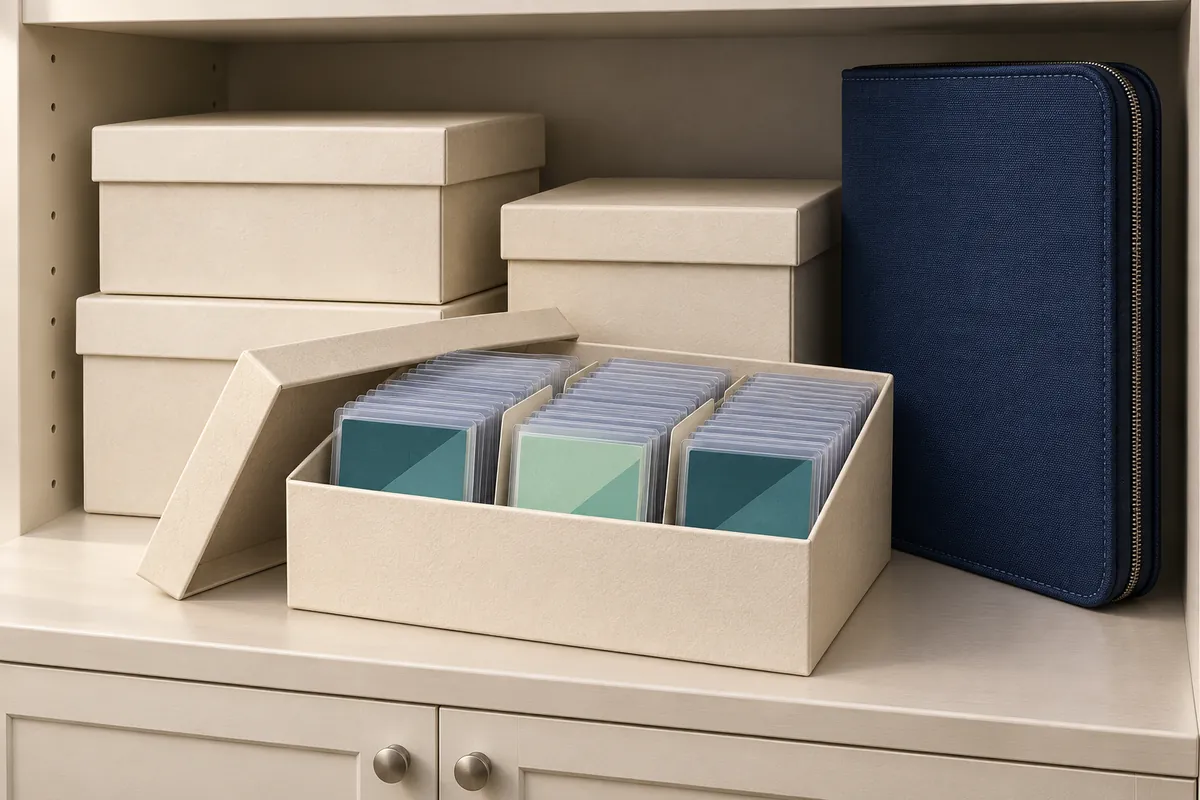
Make three groups: cards you play, cards you browse and cards you rarely need to handle. They do not have to share one storage format. A deck box may be convenient for playing; an album makes a set readable; individually protected cards may need a different box altogether.
For each group, write down the complete enclosure: card → sleeve → pocket or holder → binder or box. Check every connection. A box sold for loose cards may not accept the extra height of a rigid holder, while a pocket that takes one sleeve may be too tight for a second layer. Start with the protection finder and confirm the exact model's specification.
Prepare a repeatable handling station
The Library of Congress' paper-care guidance emphasises a clean work area and keeping food, drinks, tape, glue and rubber bands away from paper. Our practical application is to clear a table before sorting and keep labels on the enclosure. Do not write on a card or attach a label to it to make cataloguing easier.
Work in a manageable batch. Have the destination sleeves and dividers ready, return each batch to storage, then start the next. If you stop halfway through a set, leave a note in the inventory describing what remains; you should not need to remove everything again to remember.
Make inspections useful
Pick a reminder you will actually follow, and check again after a leak or an unusually damp or hot spell. This is a suggested routine, not a validated inspection interval. Look first at the shelf, then the outer packaging, then a small representative selection of enclosures. Record what changed and the action taken.
If you find a sticking surface, suspected mould or water damage, stop routine handling and seek qualified conservation advice. Avoid improvised cleaning, heating or flattening treatments. Improving the room and enclosure is different from treating an already damaged card.
Give future additions somewhere to go
Leave planned space for additions rather than making a closure squeeze the collection together. Keep spare compatible sleeves identified in their original packaging, so a later replacement does not depend on guessing the size. Use the collection inventory guide to record locations, and read storage materials explained before replacing unknown enclosures.
Sources & checks
- US National Archives: storing family papers and photographs · Checked 2026-11-02
- Library of Congress: care of works on paper · Checked 2026-11-02